
Completing Live Streaming Functional Modules of Custom E-Commerce Malls,2026 WeChat Mini Program Live Commerce Solution for Raw Material & Source Suppliers
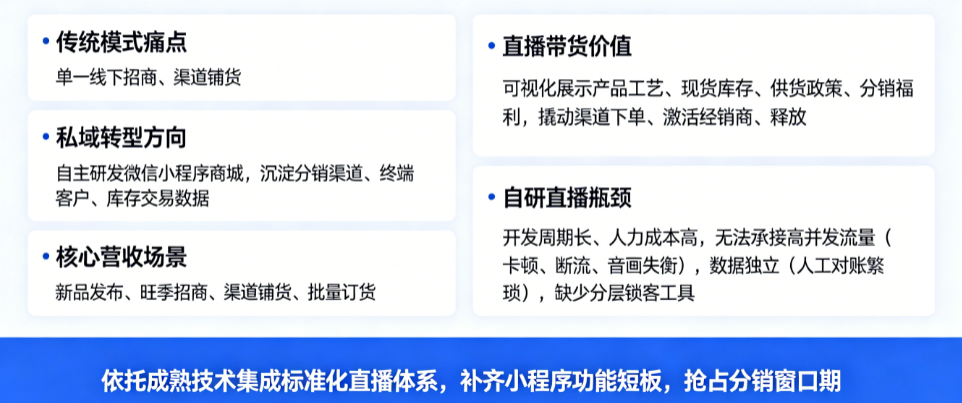
Against the backdrop of digital transformation in industrial distribution, upstream manufacturers are gradually moving beyond the traditional model of offline investment attraction and channel stocking. Many have built self-developed WeChat Mini Program malls to privately store core business data including distribution channels, end customers, inventory and transactions, thereby creating exclusive private domain operation hubs for their brands.
For upstream suppliers, core revenue-generating scenarios include new product launches, peak-season channel recruitment, bulk stocking and wholesale order taking. Live commerce, with its visual, real-time and interactive features, enables vivid demonstrations of product craftsmanship, spot inventory, supply policies and distribution incentives. It has become a pivotal tool to drive bulk channel orders, boost dealer engagement and rapidly boost sales of new products.
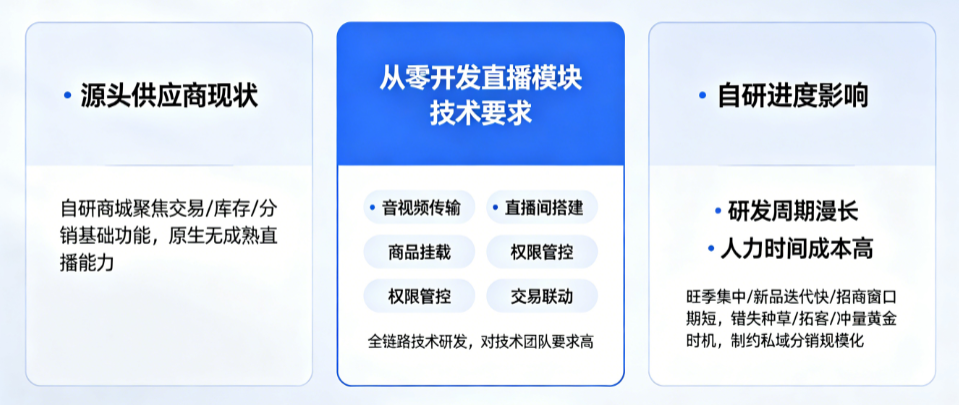
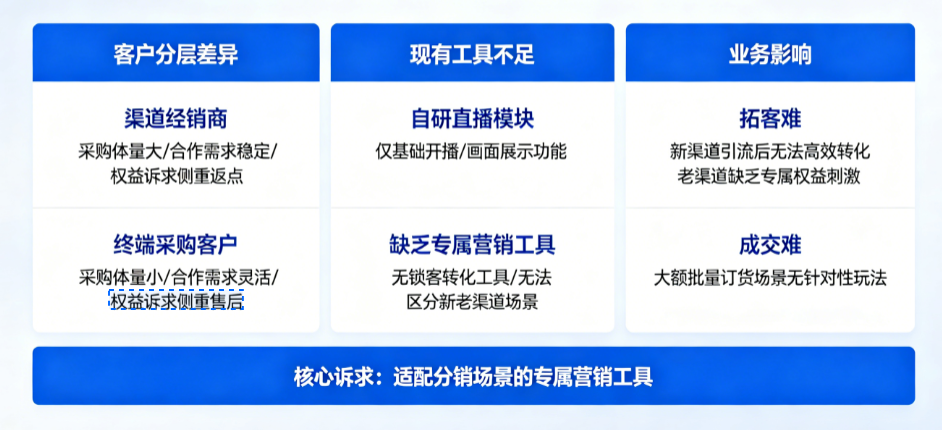
Most source suppliers rely on internal technical teams to build self-developed WeChat Mini Program malls, granting them independent control over core basic functions such as product listing, order settlement, member management and channel distribution. However, building a live streaming module from scratch brings multiple drawbacks: long development cycles, steep labor costs that fail to meet the fast launch demands of peak distribution seasons, and underdeveloped in-house live streaming architectures unable to handle high-concurrency traffic. This frequently causes live stream stuttering, disconnections and audio-video desync issues. Furthermore, siloed data between live streaming systems, malls, inventory ledgers and commission records creates cumbersome and error-prone manual reconciliation workflows. The lack of tiered customer engagement tools tailored to distribution scenarios severely restricts scaled growth of suppliers’ private domain distribution businesses.
Against this industry backdrop, rapidly integrating standardized live streaming systems via mature technical capabilities to fill functional gaps in self-developed Mini Program malls has become critical for source suppliers to seize distribution windows and efficiently expand customer bases and revenue.
I. Core Pain Points of Live Streaming on Source Suppliers’ Self-Built WeChat Mini Programs
(I) High Independent R&D Costs and Slow Rollout Miss Channel Recruitment Opportunities
Self-developed WeChat Mini Program malls built by source suppliers prioritize basic transaction, inventory and distribution functions, with no native mature live commerce capabilities. If internal technical teams develop live streaming modules from scratch, full-stack R&D covering audio-video transmission, live room setup, product linking, permission control and transaction linkage is required. This demands advanced technical expertise and results in lengthy development cycles and substantial labor and time investment.
Distribution industries feature concentrated peak seasons, fast new product iteration cycles and narrow windows for channel recruitment. Slow in-house development delays the launch of live commerce functions, causing brands to miss golden opportunities for new product promotion, bulk channel expansion and peak-season sales surges, and hinders scaled deployment of private domain distribution operations.
(II) Weak Peak Concurrency Capacity Compromises Live Streaming Stability Under Heavy Traffic
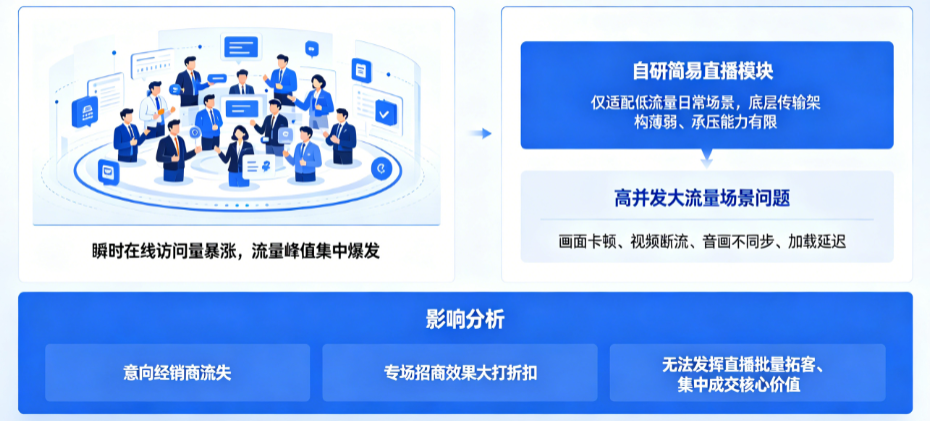
During new product launch events, distribution recruitment special sessions and peak stocking live streams, massive volumes of dealers and end buyers flood live rooms simultaneously, creating sharp instantaneous traffic spikes. Simple in-house live streaming modules are only optimized for low-traffic daily scenarios, lacking dedicated technical tuning for high-concurrency, large-viewership events. Their underlying transmission frameworks are fragile with limited load-bearing capacity.
Traffic surges commonly trigger screen stuttering, stream disconnections, audio-video desynchronization and loading delays, severely harming viewing experiences and purchase decisions of channel clients. Unstable live streaming directly drives away prospective dealers and undermines recruitment event outcomes, negating live commerce’s core value of bulk customer acquisition and centralized deal closure.
(III) Siloed Multi-System Data Creates Operational Risks via Manual Reconciliation
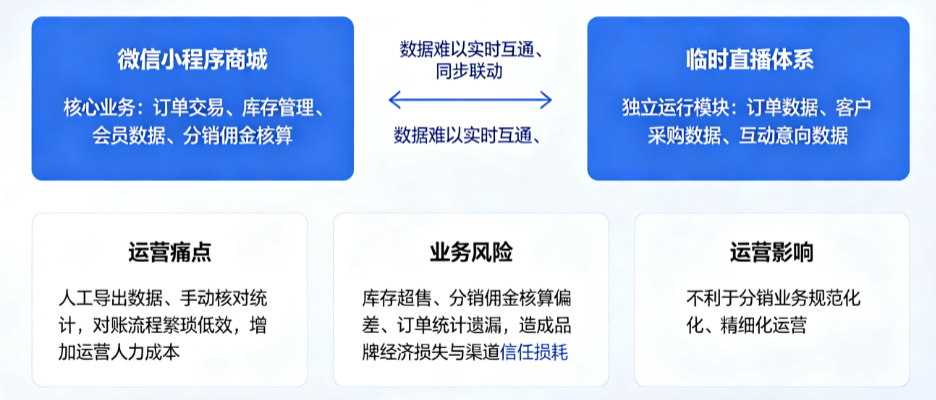
Suppliers’ self-developed Mini Program malls host core business workflows including order processing, inventory management, member data and distribution commission accounting. Custom-built live streaming systems operate as standalone modules, preventing real-time data synchronization and linkage between the two platforms.
Live stream-generated order data, customer procurement records and lead intention data cannot be synced to mall ERP and CRM systems, while inventory fluctuations and distribution commission calculations fail to feed back into live rooms in real time. Operations teams must manually export, cross-check and tally data, creating inefficient reconciliation workflows and inflating labor costs. Disjointed data also spawns critical risks such as over-selling due to inventory mismatch, miscalculated distribution commissions and missing order statistics, leading to financial losses and eroded trust among distribution partners, obstructing standardized and refined distribution operations.
(IV) Insufficient Marketing Tools Prevent Tiered Operations to Drive Bulk Transactions
Source supplier live streams primarily serve channel dealers and bulk end buyers, whose procurement volumes, cooperation demands and benefit entitlements vary drastically across partnership tiers. Distribution-specific marketing tactics are required to incentivize bulk ordering. Yet in-house live streaming modules only support basic broadcast and display functions, lacking dedicated marketing tools built for distribution scenarios. Without customer retention and conversion utilities, brands cannot tailor operations for new channel acquisition, existing dealer retention and large-volume wholesale orders, failing to motivate dealers to place bulk or restock orders. Live traffic generated via content promotion thus struggles to convert into tangible sales.
II. Solutions to Live Streaming Challenges for Source Suppliers’ WeChat Mini Programs
As a leading enterprise video SaaS provider, Polyv specializes in enterprise live streaming and video cloud services, serving over 290,000 corporate clients and ranking first among enterprise live streaming vendors for consecutive years. Polyv delivers standardized, quickly integrable and deeply customizable end-to-end live commerce solutions for enterprises operating self-developed WeChat Mini Programs and proprietary apps.
Its platform boasts core capabilities including professional audio-video live streaming hosting, cross-system integration, full-domain data linkage and private domain marketing conversion. Deep integration with internal corporate business systems eliminates the need for enterprises to develop underlying live streaming architectures independently, enabling rapid deployment of stable, mature live commerce ecosystems on proprietary private domain channels and delivering standardized technical and operational support for digital private domain management.
(I) Lightweight Rapid Integration to Cut Self-Development Lead Times
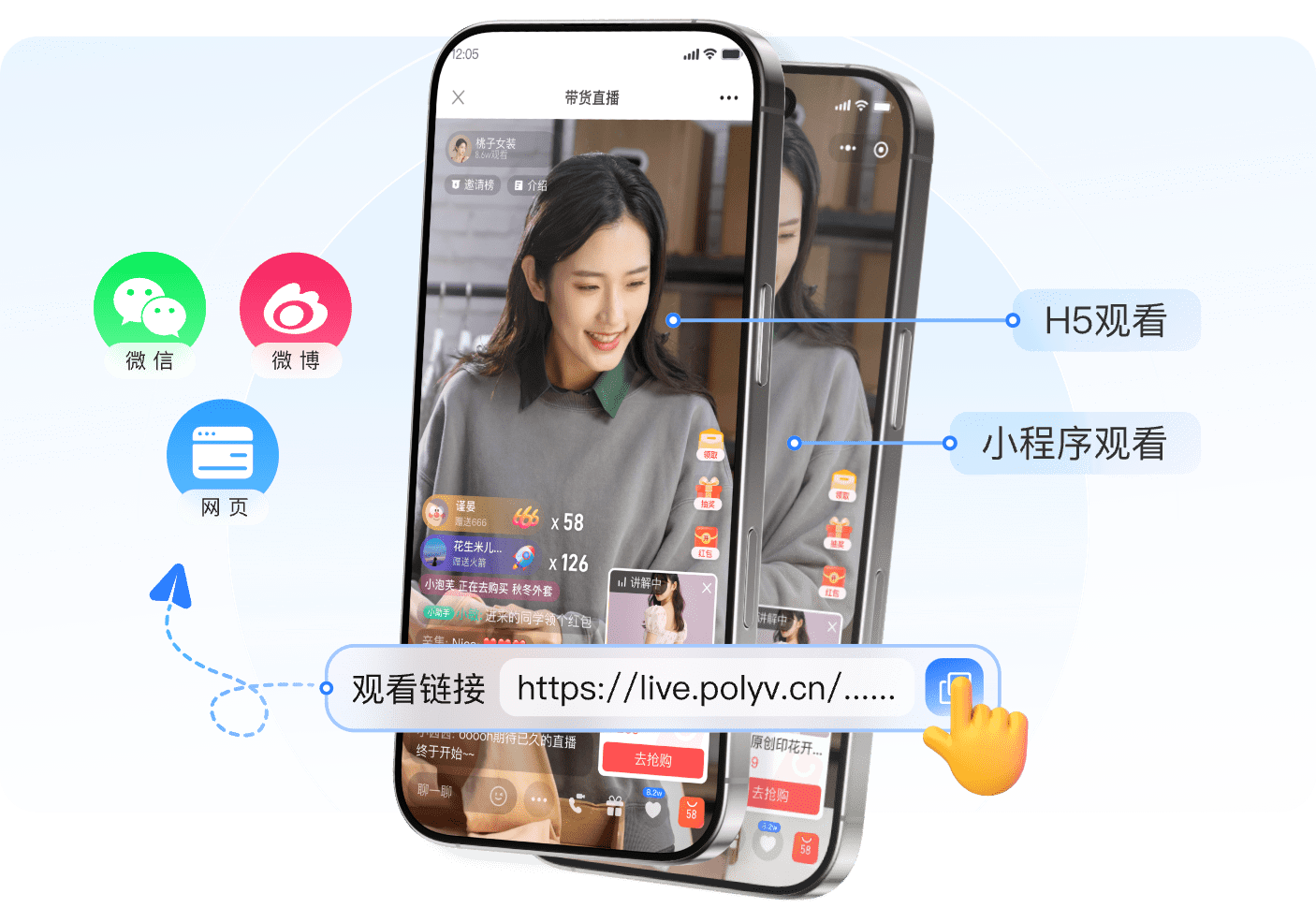
To address high R&D costs and slow rollout cycles of in-house Mini Program live streaming, Polyv provides complete SDK secondary development and UniApp cross-end integration solutions, with over 400 standardized open API interfaces. Live rooms can be seamlessly embedded into WeChat Mini Programs, apps or websites, while H5 links support one-click sharing to social groups for instant live commerce activation.
Deep integration with existing corporate mall systems is supported, enabling full customization of live room interfaces, functional modules and data tracking points — ideal for brands requiring connectivity with member and CRM systems. This drastically reduces technical R&D expenses and shortens project delivery timelines, empowering brands to capitalize on peak distribution expansion windows and rapidly add live commerce functionality to self-built Mini Program malls.
(II) Robust Technical Architecture to Support High-Concurrency Live Streams During Peak Seasons
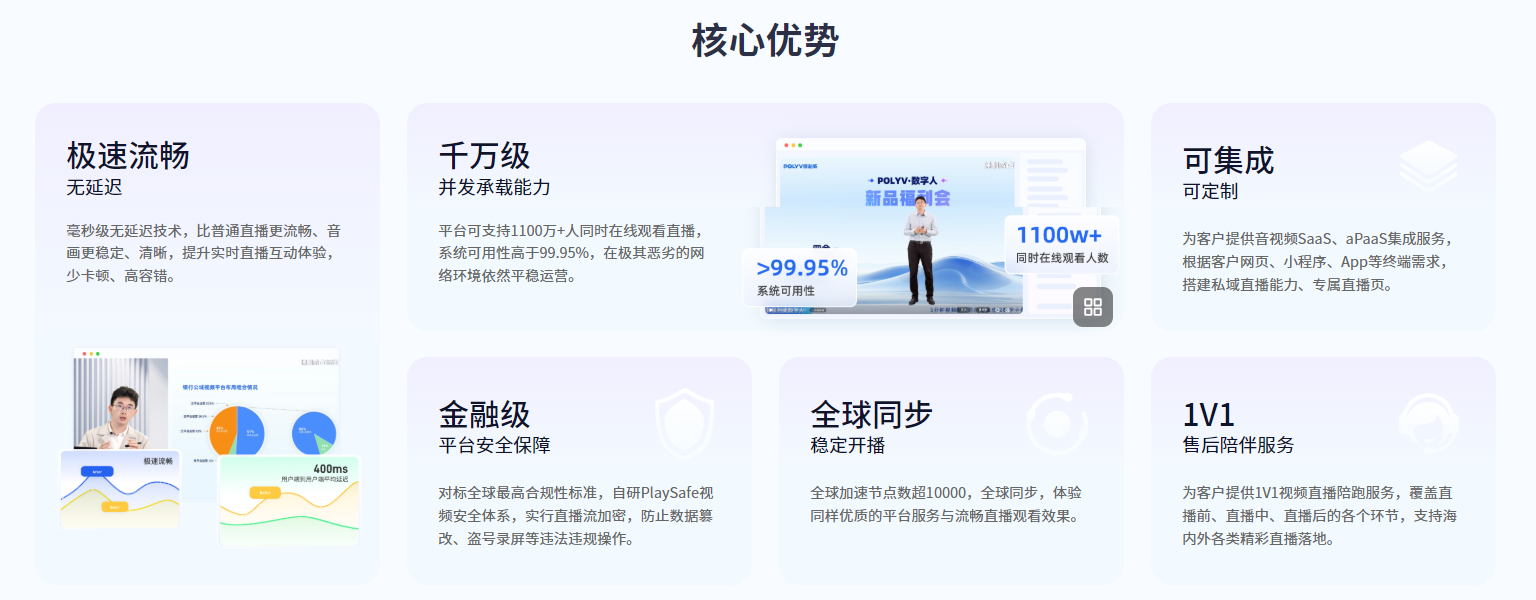
To resolve stream stuttering under heavy concurrent traffic, Polyv delivers million-view concurrent live streaming capacity powered by PRTC low-latency technology, a globally distributed CDN node network and weak network optimization algorithms. These technologies guarantee smooth playback during high-traffic recruitment and bulk stocking live events, securing optimal campaign outcomes.
(III) Full-Domain API Integration to Build Closed-Loop Business Data Linkages
To break down data silos across disparate systems, Polyv’s PaaS integration suite offers SDK and API interfaces for deep interconnection with proprietary corporate business systems, enabling seamless alignment between live rooms and member/CRM platforms.
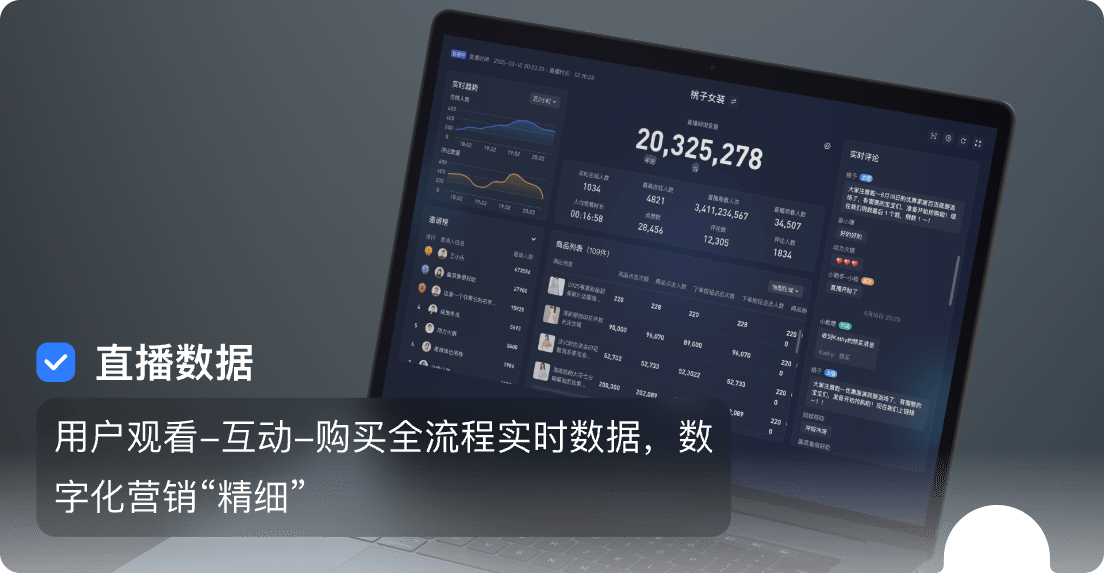
Polyv provides a complete pre-live, mid-live and post-live data analytics pipeline covering metrics including traffic access, view duration, click conversions, product purchases, user behavior journeys, sharing sources and referral performance, allowing merchants to fully measure live stream performance. Multi-dimensional statistical dashboards with visual reporting feed live order data, customer procurement records and lead intent data back to corporate mall systems, forming a closed data loop spanning live broadcast, data analysis and business decision-making.

(IV) Diverse Distribution Marketing Tools to Boost Bulk Order Conversin
Catering to suppliers’ demand for bulk customer acquisition and sales, live rooms come pre-equipped with a full suite of marketing tools tailored for B2B distribution scenarios, including supply-session flash sales, distribution group buys and lucky draw gift bags.
Brands can create time-limited stocking urgency via flash sales, drive coordinated bulk orders from channel partners through group buys, and boost live room engagement and viewer retention with lucky draws. These multi-pronged tools stimulate purchasing intent among distribution clients, resolve low conversion rates and slow bulk order uptake in live streams, and maximize revenue growth from live commerce distribution channels.

III. Core Business Value of Deploying Live Streaming Ecosystems for Suppliers’ WeChat Mini Programs
As competition intensifies across industrial distribution, source suppliers’ private domain digital capabilities and refined channel operation expertise have become core differentiated competitive moats. Traditional self-developed WeChat Mini Programs suffer from inadequate live streaming functionality, fragile technical load-bearing capacity, disjointed data frameworks and limited marketing tactics, rendering them unable to meet high-frequency business demands such as peak-season recruitment, new product stocking and channel expansion. These limitations severely cap revenue growth of private domain distribution businesses.
Polyv’s private domain live streaming platform delivers end-to-end capabilities spanning Mini Program/app live streaming integration and private domain monetization tools including flash sales, red envelopes, gift bags and coupons. It comprehensively helps source suppliers fill live streaming gaps in self-built mall platforms, enabling fast deployment of stable, connectable and monetizable private live streaming ecosystems without prohibitive independent R&D expenditure.
The solution dismantles cross-system data barriers, streamlines distribution reconciliation workflows, enables tiered channel marketing operations, and helps brands seize channel expansion windows. It unlocks value from private domain channel assets, accelerates new product stocking and bulk order conversion, and builds a sustainable, growth-oriented closed-loop live commerce distribution system. Ultimately, it drives industrial digital transformation and sustained revenue growth for enterprises.