
Stable Operation of Large-Size Live Classes for K12 Institutions: High-Concurrency System Teaching Solutions for Online Large-Class Teaching
With the continuous implementation of digital education policies, the K12 online education and training industry has moved beyond extensive traffic-driven growth and entered a standardized development stage centered on teaching quality, classroom experience and refined learning situation management. Featuring flexibility, high reusability and inclusive resource access, online large-size live classes, combined with the dual-teacher teaching model of “lead teacher lecturing plus assistant teacher supervision”, have become the mainstream service model for institutional large-scale teaching and student development. Currently, most K12 institutions rely on proprietary student apps to undertake online teaching businesses. However, teaching traffic in the industry is highly concentrated on weekends, with multiple large-size classes of hundreds of students running simultaneously. This imposes stringent requirements on the live streaming system in terms of high-concurrency bearing capacity, operational stability, multi-terminal compatibility, post collaboration and data review capabilities. Generic live streaming tools on the market suffer from insufficient concurrency capacity, lack of professional teaching permissions, incomplete learning situation data and high independent R&D costs. They are prone to problems such as classroom stuttering, disconnection, interaction timeout and disordered teaching procedures, which seriously undermine teaching delivery quality and student experience, and restrict the standardized and large-scale development of institutional online teaching.
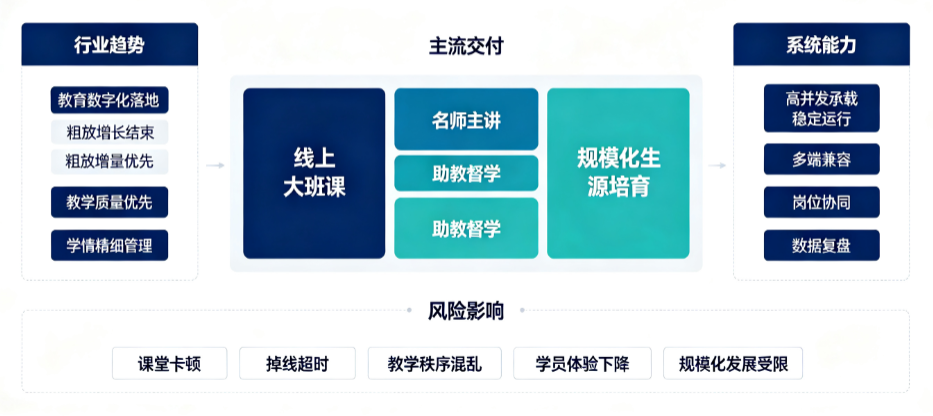
I. Core Challenges of K12 Online Large-Class Live Teaching
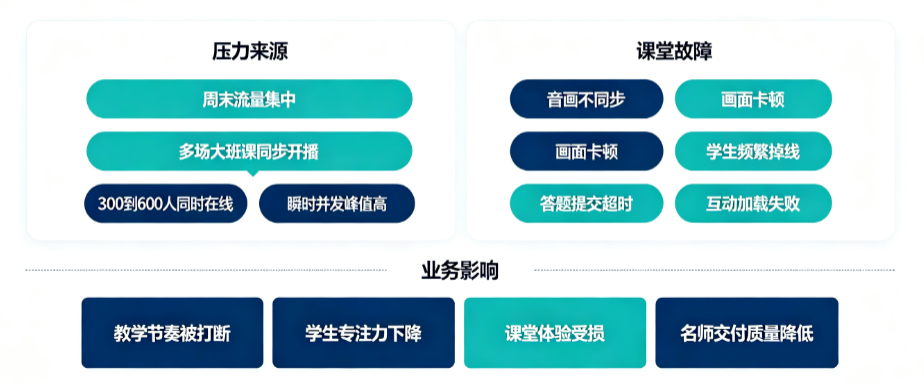
(I) Concentrated Weekend Traffic Peaks Lead to Insufficient Stability of High-Concurrency Classrooms
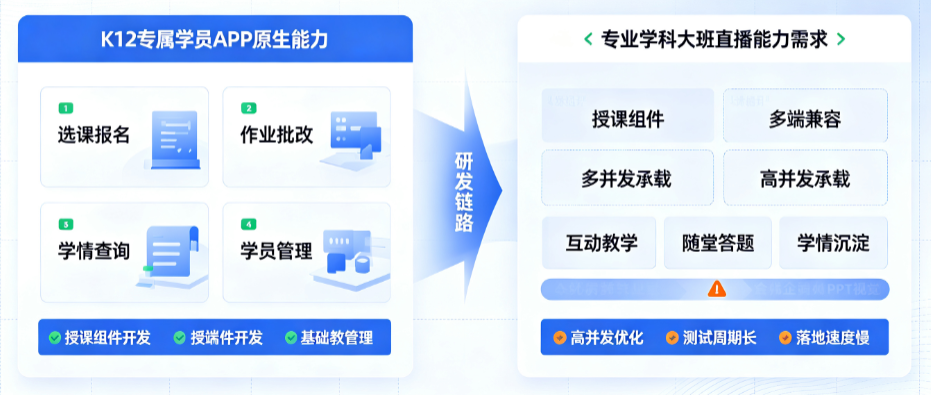
(II) Proprietary Apps Lack Built-in Live Streaming Capabilities with Long R&D Cycles and High Costs
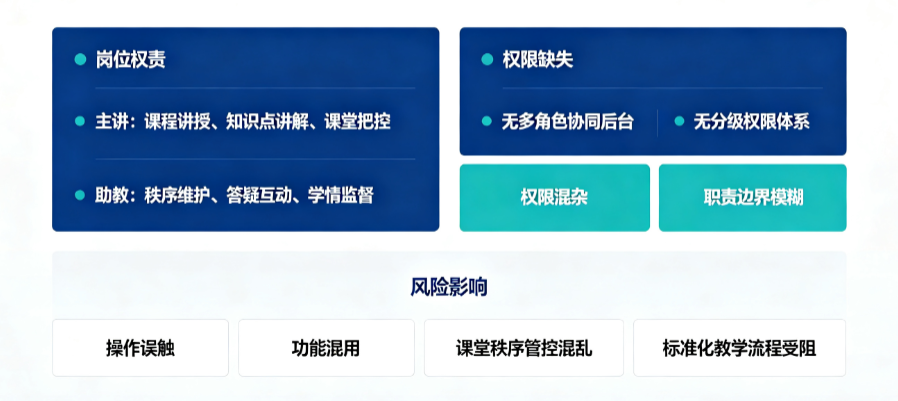
(III) Complex Roles in Large-Class Teaching Cause Confused Multi-Post Collaboration and Rights Management
The mainstream teaching model of K12 online courses adopts dual-post collaboration: elite teachers are responsible for lecturing, knowledge explanation and classroom control, while teaching assistants undertake order maintenance, interactive Q&A and learning situation supervision, with distinct job responsibilities and operational authorities. However, ordinary live streaming platforms lack a multi-role collaborative backend and hierarchical permission system, leading to mixed operational rights and blurred responsibility boundaries between teachers and assistants. This easily causes accidental operations, functional misuse and chaotic classroom management, failing to support standardized and standardized collaborative teaching processes for large-class courses.
(IV) Incomplete Learning Situation Data System Hinders Iterative Optimization of Courses
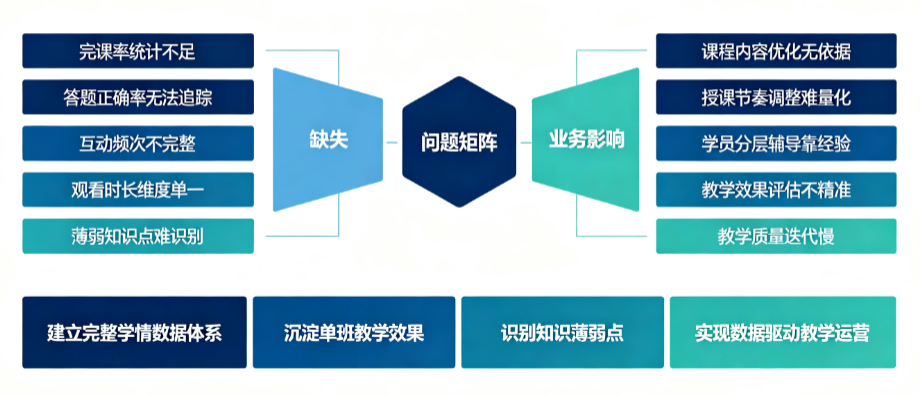
K12 subject teaching relies on continuous classroom data analysis to iterate course content, adjust teaching rhythms and conduct targeted knowledge gap remediation. Traditional large-class live streaming systems lack a comprehensive learning situation data statistics system, and cannot accurately collect core teaching indicators such as course completion rate, in-class answer accuracy, classroom interaction frequency and viewing duration. Institutions are unable to quantify the teaching effect of each class or identify students’ weak knowledge points. Course optimization, teaching method adjustment and differentiated student tutoring rely solely on manual experience without data support, making refined teaching operation and continuous teaching quality iteration unattainable.
II. Solutions for Stable Operation of K12 Online Large-Class Live Teaching
(I) Global Network Architecture Ensures Stable Teaching During Traffic Peaks
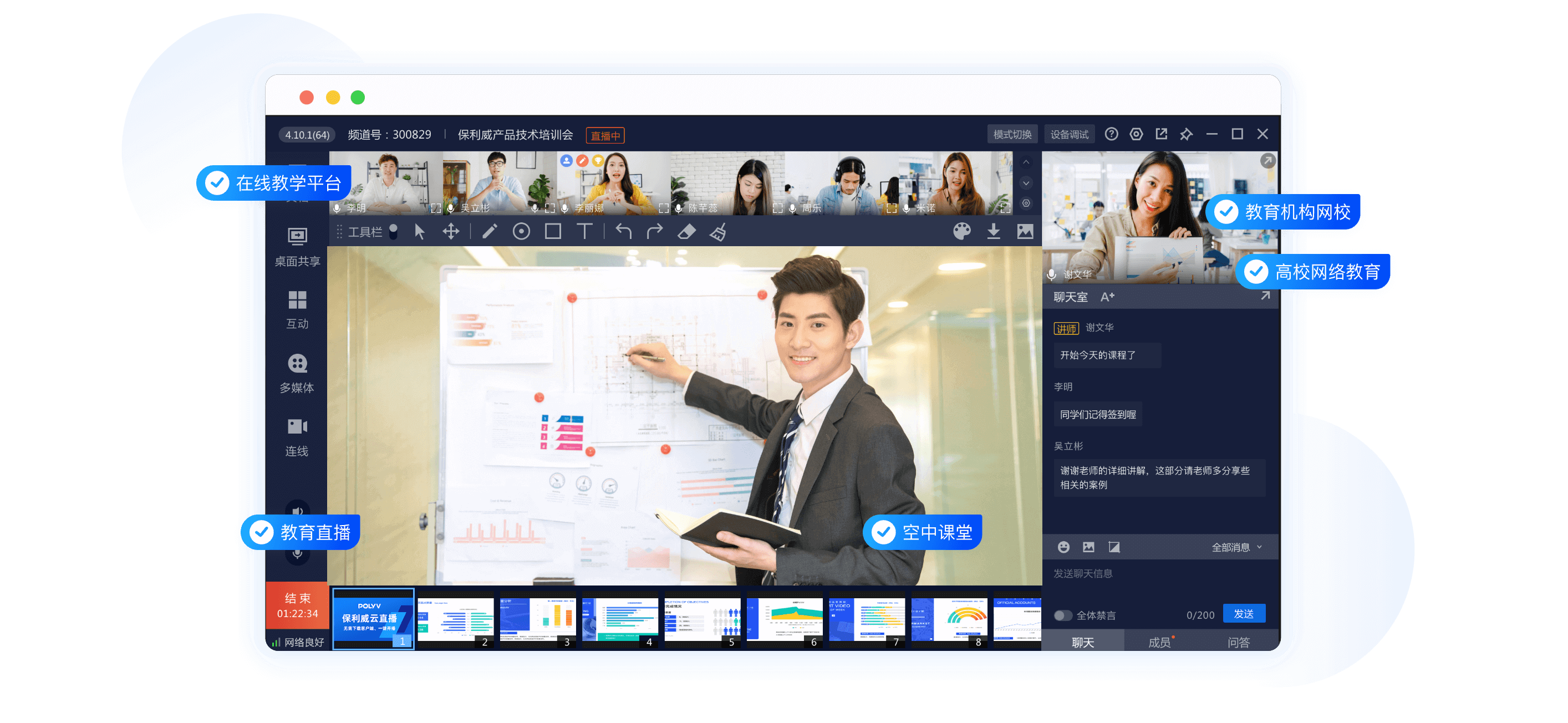
Leveraging the global distributed CDN network and intelligent node scheduling technology, combined with core capabilities including adaptive bitrate and weak network optimization, the solution is specially optimized for the ultra-high concurrent and multi-class simultaneous teaching scenarios on weekends. It effectively bears the instantaneous traffic pressure of hundreds of people per large class, significantly reduces classroom failures such as stuttering, disconnection and audio-video delay, and stabilizes the overall teaching order. Students can achieve smooth listening, normal interaction and stable answer submission regardless of network conditions, solving the problem of system collapse during peak hours and ensuring high-quality and stable delivery of every large-class course.
(II) Lightweight Embedding of Standardized SDK Enables Rapid App Live Streaming Implementation
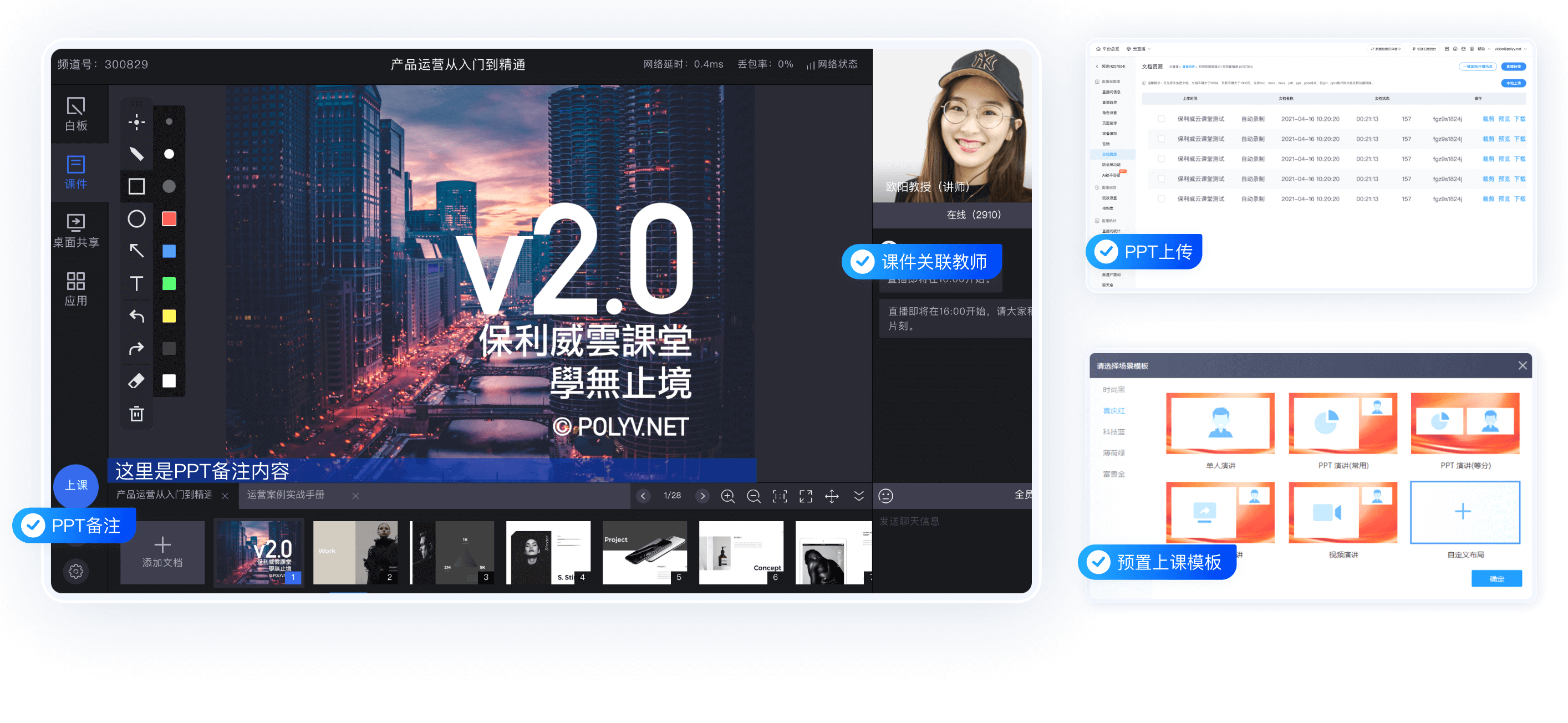
The solution provides mature and standardized uni-app live streaming SDKs, which support lightweight full embedding into institutional uni-app projects and one-stop adaptation for student apps and WeChat mini-programs. Featuring out-of-the-box deployment and rapid launch, it enables institutions to avoid zero-based R&D and multi-terminal debugging. It fully supports complete live streaming capabilities for K12 subject teaching, in-class interaction and batch course launching, greatly reducing multi-terminal R&D costs and shortening project launch cycles. It quickly meets the demand of centralized large-class teaching on weekends and adapts to the normalized and large-scale operation of institutional online teaching.

(III) Hierarchical Multi-Role Permissions Standardize Collaborative Teaching Processes
The system supports refined hierarchical configuration of multi-role permissions, clearly defining and isolating the job responsibilities and operational boundaries of lecturers and assistants. Equipped with an exclusive management backend and independent operation channel for assistants, it enables assistants to independently complete bullet screen management, classroom order maintenance, Q&A response, student supervision and data statistics without interfering with teachers’ normal lecturing. It eliminates the problems of chaotic multi-role operation and blurred permissions on traditional live streaming platforms, standardizes the mature “elite teacher lecturing + assistant supervision” large-class teaching model, and comprehensively improves classroom teaching and operation efficiency.
(IV) Full-Dimensional Learning Situation Data Dashboard Drives Refined Teaching Iteration
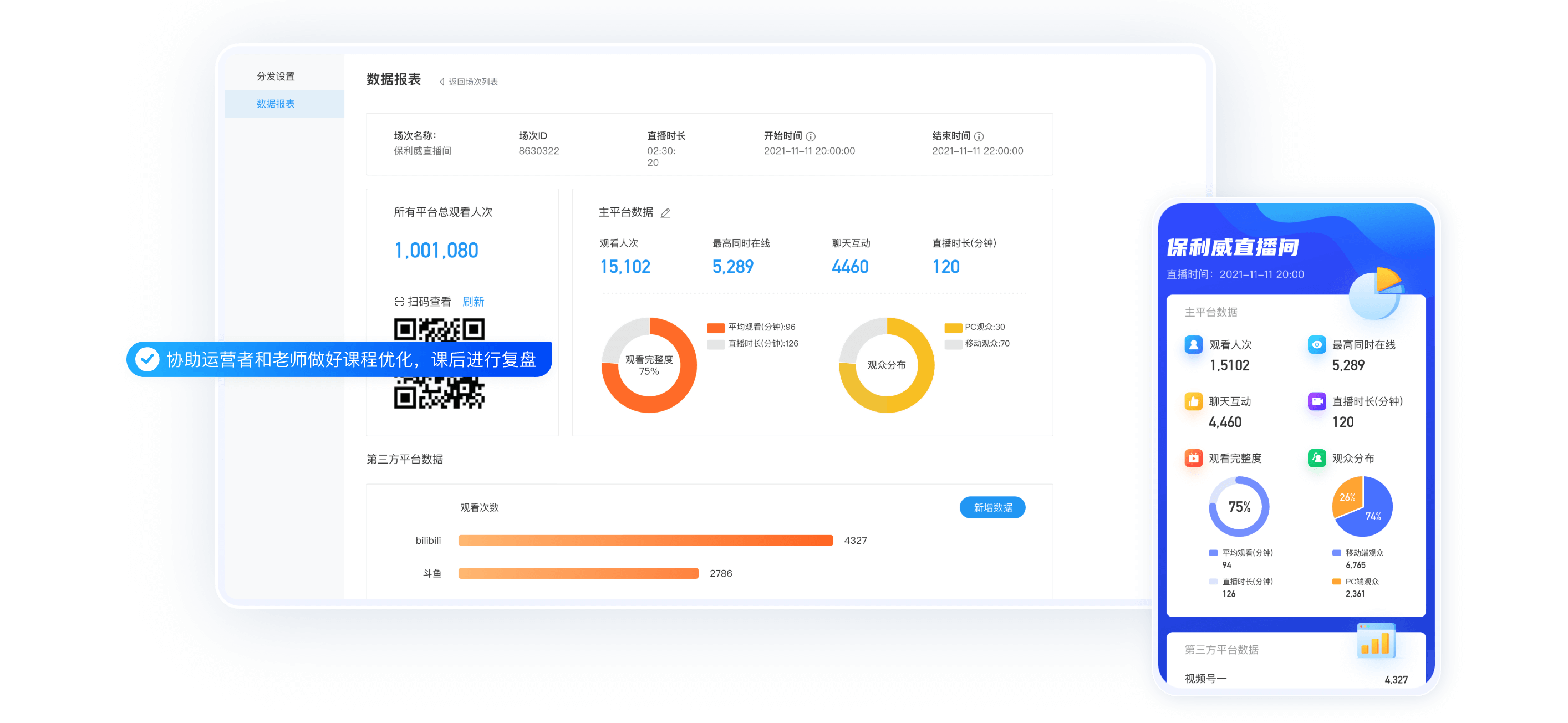
A visualized full-dimensional classroom learning situation data dashboard is built to automatically collect and analyze all-round teaching data, including students’ viewing duration, course completion status, in-class answer accuracy, interaction frequency and classroom access tracks. It supports one-click export of data reports and seamless API docking with institutional proprietary learning situation systems. This helps teaching and research teams accurately review the teaching effect of each class, pinpoint students’ knowledge weaknesses and summarize teaching problems. Real classroom data empowers course content optimization, teaching rhythm adjustment and differentiated tutoring, eliminating experience-based teaching and realizing the upgrading of refined operation for K12 online teaching.
III. Core Value of Solution Implementation