
Stagnant Private Domain Conversion & Unstandardized Teaching? 2026 Digital Operation Solutions for Adult Education and Training
The domestic adult education and training industry has completely bid farewell to the extensive era of traffic dividends and fully entered a new stage of refined stock competition. In the early stage of industrial development, most institutions achieved rapid user growth and revenue breakthroughs relying on high-quality course content, public domain traffic distribution, and low-price drainage models. However, with the continuous influx of market players and the continuous upgrading of users’ consumption perceptions and learning demands, homogenized course content, single product sales models, and rudimentary online teaching experiences can no longer support the long-term operation of institutions or meet users’ demands for high-quality online learning.
Compared with the children’s education and training track, the adult education and training industry boasts strong exclusive attributes. Most adult learners study in fragmented spare time such as commuting gaps, after work, and on weekends without mandatory supervision scenarios. They attach greater importance to learning flexibility, class accessibility, course practicality, and final learning outcomes.
At this stage, the vast majority of adult education and training institutions adopt a normalized teaching model dominated by recorded courses and supplemented by live instruction, which is currently the most compatible and widely recognized teaching structure for adult learning rhythms. Nevertheless, mainstream general live streaming and video tools in the market are mainly developed for mass entertainment and ordinary live streaming scenarios, lacking in-depth scenario adaptation for the adult education and training industry. Such tools generally suffer from scattered functions, weak customization capabilities, isolated systems, and insufficient data statistics. These problems directly lead to low standardization of online teaching, uneven user learning experiences, and sluggish course renewal and repurchase rates, severely restricting the digital transformation and large-scale development of educational institutions.
I. Core Practical Pain Points in the Adult Education and Training Industry
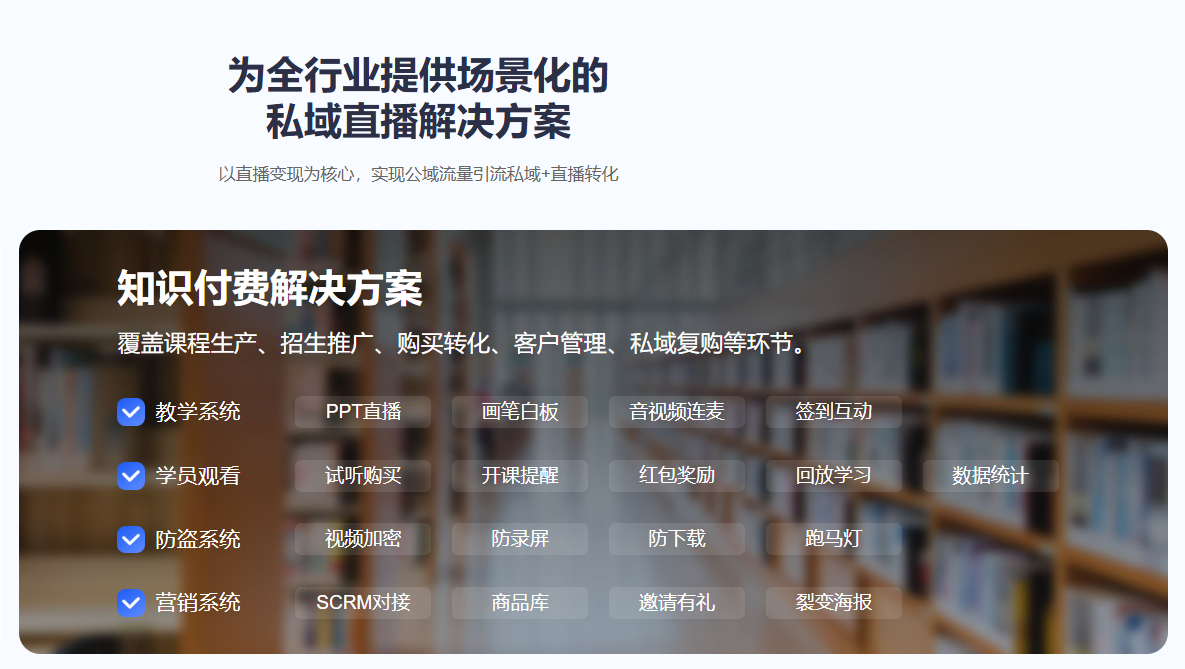
1. Insufficient Adaptability of General Tools Fails to Support Standardized Teaching Delivery
Normalized recorded courses and live Q&A training have long been verified as mainstream teaching modes in the adult education and training industry. To control operational costs and simplify processes, most institutions currently adopt general video tools such as short-video platforms and basic live streaming plugins. These tools only meet elementary requirements for video playback and live broadcasting, failing to adapt to exclusive vocational education teaching scenarios.
General tools do not support branded customized deployment or in-depth docking development of mini-programs and official website web pages. Institutions are unable to build exclusive online classrooms tailored to their brand images, with teaching interfaces, course display forms, and core functional modules limited to universal templates that cannot match standardized teaching processes. Meanwhile, these tools lack professional course delivery systems and hierarchical permission management capabilities, making it impossible to distinguish learning content based on users’ course purchase rights and implement refined teaching management.
Course content security also constitutes a core industrial challenge. General tools are not equipped with professional protection capabilities such as video encryption, anti-piracy playback, and watermark traceability. Self-developed high-quality courses of institutions are prone to screen recording leakage, unauthorized dissemination, and piracy resale. The failure to effectively protect core teaching assets results in intellectual property loss and damaged brand reputation, preventing the establishment of standardized and professional online teaching systems.
2. Isolated Multi-Channel Systems Reduce Conversion and Repurchase Rates via Cumbersome Learning Links
Private domain precipitation and independent transactions serve as the core revenue sources for education and training institutions. Most institutions have launched exclusive WeChat mini-programs for public domain drainage, course display, online order placement, and private domain transactions. However, the industry generally faces channel isolation, where transaction channels and teaching channels operate independently with disconnected data and processes.
Mini-programs undertake user order placement and transaction functions, while course delivery relies on third-party platforms or web pages. After paying for courses, users cannot automatically unlock corresponding learning permissions and have to go through cumbersome operations including manual review, manual verification, and cross-platform jumps to access courses. Given adults’ limited initiative in autonomous learning, complicated procedures directly weaken users’ willingness to learn, leading to a large number of post-purchase dropouts and a sharp decline in course completion rates. Meanwhile, poor learning experiences undermine user satisfaction, significantly reducing learners’ willingness to renew courses, repurchase new courses, and make word-of-mouth referrals. This causes severe traffic waste and low overall conversion efficiency, greatly restricting the long-term operation of private domain users and overall revenue growth.
3. Severe Global Data Silos Hinder Refined Operation and Teaching Optimization
In the stock competition era, the core competitiveness of institutions stems from data-driven refined operations. Course iteration, teaching optimization, user stratification, and precise enrollment all rely on complete and authentic learning data. Currently, user data of most institutions are scattered across multiple terminals such as mini-programs and web pages, forming isolated data silos.
Core learning data including users’ learning progress, class duration, classroom interaction, course completion rates, video playback and exit nodes cannot be uniformly summarized and analyzed. General tools do not support customized data tracking, making it impossible for institutions to capture users’ full-link behavioral trajectories or accurately identify course deficiencies and learning pain points.
As a result, institutions can only adjust teaching and operation strategies based on experience and subjective judgment, unable to implement refined operations such as stratified teaching, precise community activation, and targeted marketing enrollment. Slow course iteration, inefficient user activation, and stagnant enrollment growth trap institutions in operational dilemmas including unoptimized teaching, undefined operational methods, and stagnant business growth.
II. How to Break Through Growth Dilemmas for Education and Training Institutions?
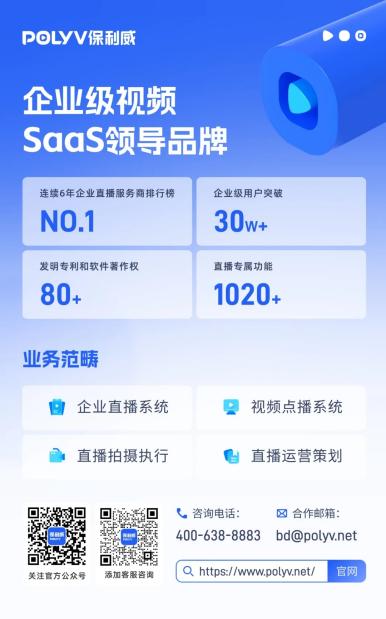
As a leading enterprise-grade video SaaS brand, Polyv targets core industrial pain points including poor adaptation of general tools, isolated systems, and fragmented data. It has developed exclusive solutions featuring integrated live and recorded streaming, interconnected dual-terminal links and unified global data. Fully adapting to adults’ fragmented learning characteristics, the solutions form a closed loop covering teaching delivery, user experience, and data-driven operation, helping institutions achieve standardized teaching, optimized user experience, and sustainable data-driven growth.
1. Integrated Live and Recorded Streaming to Build a Professional and Standardized Teaching System
Polyv is well-aligned with the mainstream teaching model of adult education and training, which prioritizes recorded courses and supplements with live sessions. It delivers a dedicated integrated online teaching platform. Institutions may flexibly combine teaching modes based on course attributes, including recorded-only courses, live-only courses, and hybrid live-recorded sessions, to fit the teaching rhythm of different courses. The platform supports permission management, enabling customized learning access configuration based on users’ purchased course rights.
In addition, Polyv is equipped with the PlaySafe® video copyright protection system, covering video encryption, anti-piracy playback, dynamic watermarks, ID scrolling traceability and other security features. It fully protects institutions’ self-developed course assets and puts an end to course leakage, unauthorized dissemination and piracy at the source. For learners, on-demand playback and flexible learning perfectly suit adults’ fragmented autonomous learning scenarios, helping them consolidate key and difficult knowledge points and improve learning efficiency. For institutions, the standardized functional system and standardized delivery process enable the rapid deployment of exclusive branded online classrooms, breaking the limitations of general tools and consolidating core competitiveness in digital teaching.
2. In-Depth Dual-Terminal System Interconnection to Build a One-Stop Learning Closed Loop
To address channel isolation, cumbersome learning procedures and low conversion & retention rates across the industry, Polyv supports API integration and full data interconnection. It can seamlessly connect with mini-programs, mobile apps, WeChat official accounts, as well as core business systems including CRM, membership systems and ERP. It unifies user data, course data and permission data across mini-programs and web terminals, completely breaking down the barriers between transaction channels and teaching channels and streamlining the entire learning process.
The smooth and streamlined full-link learning experience effectively boosts course completion rates and user stickiness, and enhances learners’ recognition and trust in institutions. It helps organizations efficiently activate private domain user assets, steadily lift course renewal, new course repurchase and word-of-mouth referral rates, and realize long-term private domain user operation and stable revenue growth.
3. Interconnected Global Data and Customized Data Tracking Empower Refined Operations
Polyv eliminates cross-terminal data silos and helps institutions establish a comprehensive and visualized user data system. It collects full-dimensional data including class duration, learning progress, course completion rates, chapter stay trajectories, classroom interactions, video playback and exit behaviors, and automatically generates professional reports for review and analysis.
In terms of operation, the comprehensive data system supports precise user stratification. Differentiated teaching plans and operational strategies can be customized for learners at beginner, advanced and sprint stages. It enables refined practices such as stratified tutoring, targeted community activation and precision enrollment marketing, putting an end to experience-based extensive operation. Driven by data, institutions can improve teaching quality, activate user resources and expand revenue, realizing scientific, refined and sustainable development of online business.
III. Reshaping the Digital Growth Model for Adult Education and Training
The core of digital transformation for adult education and training lies in the all-round upgrading of standardized teaching, optimized user experience, data-driven operation and sustainable growth, rather than simply launching online teaching channels. General video tools can only meet basic online teaching demands and fail to support the large-scale and long-term development of educational institutions. As an enterprise-grade video SaaS solution, Polyv addresses in-depth industrial pain points and delivers full-link digital upgrading capabilities for institutions from three dimensions: teaching, user experience and operation.
Against the backdrop of increasingly fierce stock competition, Polyv helps institutions build brand advantages via standardized teaching, retain user assets with premium experience, and drive sustained growth through data-based refined operation. Ultimately, it enables dual progress in teaching quality and business performance.