
Beyond Traffic: How Mini Program Live Streaming Helps Wine and Spirits Retailers Turn Private-Domain Users into Repeat Buyers
Wine and spirits retailers can use mini program live streaming to connect product storytelling, interaction, ordering, data review and repeat-purchase operations inside their own private-domain base.
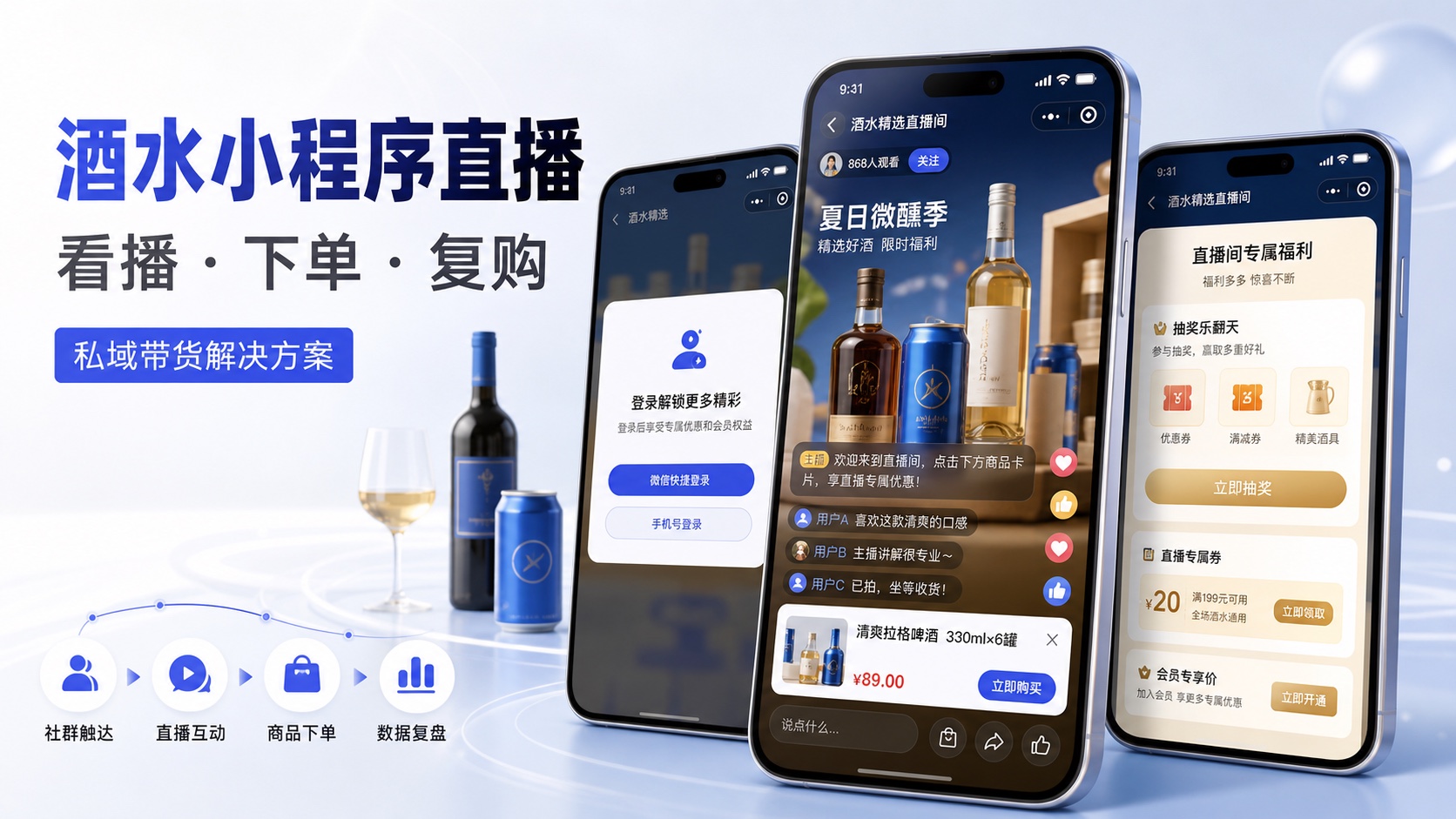
Wine and spirits live commerce is entering a more pragmatic stage.
In the past, many merchants approached live streaming by chasing public-platform traffic, hiring influencers, and increasing paid media spend. But for wine and spirits retailers that already have a mini program, the required operating qualifications, and a basic WeChat private-domain user base, the real question has changed. It is no longer simply whether they should run live streams. It is whether live streaming can be embedded into their own mini program, so that every view, consultation, order, and repeat purchase remains inside their own private-domain operating system.
These merchants are often not starting from zero. Some already have the required food and beverage business qualifications, their own mini program, and perhaps dozens of viewers entering a single live session. But the broadcast rhythm may still be unstable, and the operating model may not yet be repeatable. On the surface, this looks like a question of which live streaming tool to choose or how much a solution costs. At a deeper level, it is about the system capabilities a wine and spirits retailer needs when moving from one-off live sessions to long-term private-domain operations.
01 Why Is Mini Program Live Streaming Suitable for Wine and Spirits Commerce?
Wine and spirits consumption has a clear characteristic: it is neither purely impulse-driven nor determined only by low prices.
When customers buy a bottle of wine or spirits, they often care about origin, taste profile, vintage, brand story, drinking occasions, gifting value, and after-sales assurance. Live streaming is well suited to explaining these details. A host can compare different products, show packaging and gift boxes, introduce use cases such as business banquets, family gatherings, holiday gifting, and friend get-togethers, and answer real-time questions about pricing, inventory, delivery, and pairing.
But if the live stream happens only on a public traffic platform, merchants often face two problems. First, users watch and leave, making it difficult to reach them again. Second, transactions, memberships, coupons, and repeat-purchase paths are scattered across different systems. When the live-streaming buzz fades, the merchant may not have accumulated real user assets.
The value of mini program live streaming is that it connects live commerce with the merchant’s own private-domain base. Users can enter the live room from communities, official accounts, WeCom, Moments, or the mini program entrance; interact and place orders during the live session; and continue to be engaged afterward through membership programs, coupons, communities, and repeat-purchase campaigns. For wine and spirits merchants, this is more important than the traffic of a single session.
02 Three Problems Wine and Spirits Merchants Must Solve Before Live Streaming Becomes Repeatable
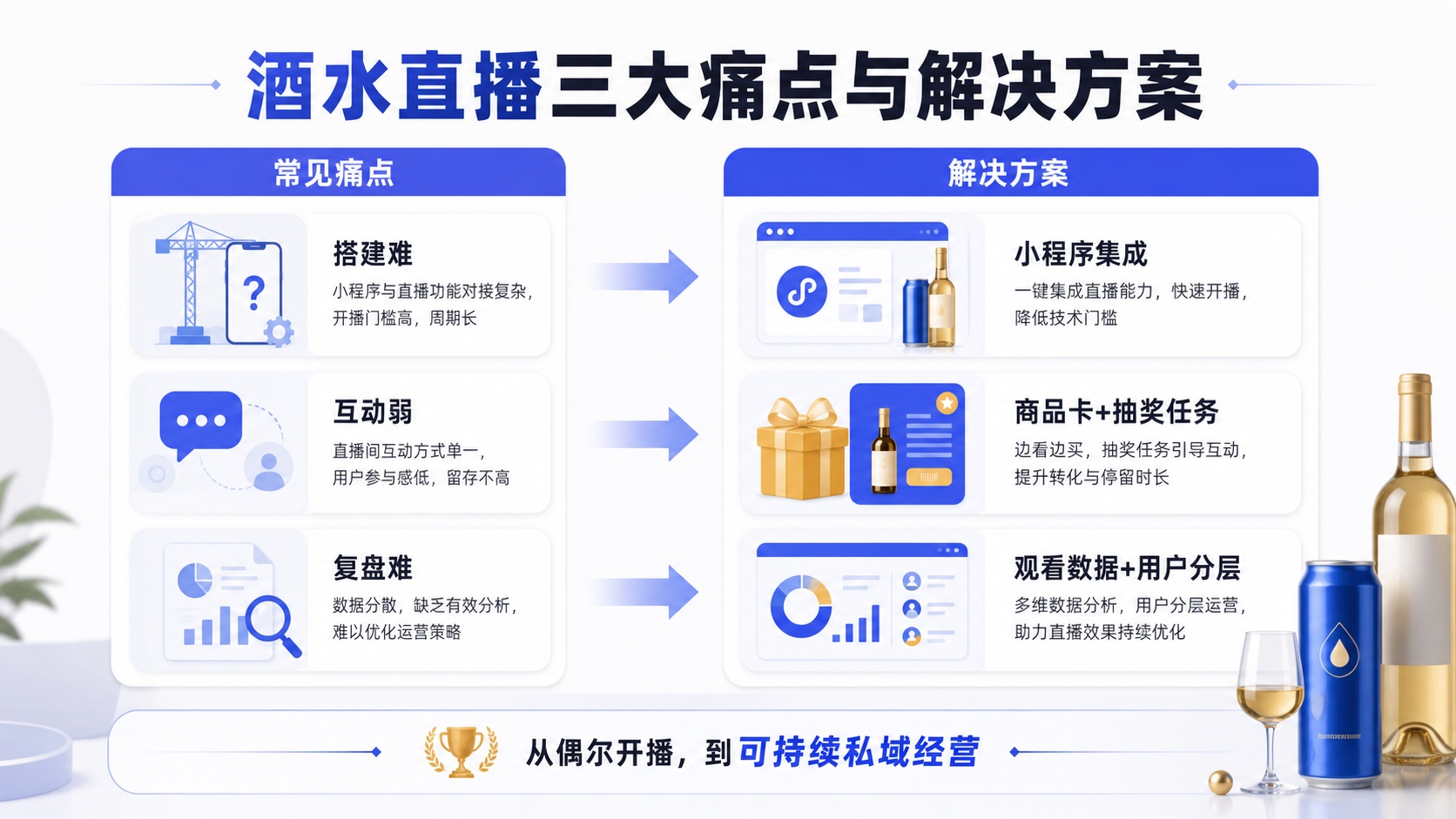
Pain point 1: The merchant has a mini program, but live streaming is hard to integrate.
Many wine and spirits merchants already have their own mini program store, but the mini program may not include mature live streaming capabilities. Being able to display products is not the same as being able to run stable broadcasts, explain products in real time, support assistant operations, interact with viewers, and review live data afterward.
Wine and spirits live commerce has relatively high requirements for the live-room experience. Products need to be displayed clearly, explanations must be stable and smooth, promotions and product cards should appear at the right moment, and user questions should be answered quickly. If the live streaming capability is separated from the mini program store, merchants may end up with viewers in one place, orders in another, and data scattered across different dashboards, increasing operational cost.
Pain point 2: When audience size is limited, refined operation matters even more.
A live session with around 70 viewers does not mean there is no value. For a private-domain wine and spirits merchant, those 70 viewers may come from communities, referrals, existing customers, and high-intent prospects. Their quality may be higher than a larger but less relevant public-platform audience. The real question is whether the merchant can identify who watched seriously, who interacted, who clicked products, and who may be likely to buy again.
If the merchant only looks at concurrent viewers, operations can easily be misled by surface-level data. Mini program live streaming should pay closer attention to viewing duration, interaction behavior, product clicks, order paths, and repeat visits. For categories such as wine and spirits, which have strong repeat-purchase and gifting characteristics, the first live session may not immediately convert every viewer. But if users can be continuously reached and segmented, later conversion opportunities remain.
Pain point 3: Unstable broadcast frequency makes live streaming hard to turn into a business process.
Many merchants start live streaming with enthusiasm and then stop because the process becomes exhausting. The first session takes a long time to prepare; the second session lacks a clear topic; the third session may be canceled because results are not yet obvious. When frequency is unstable, users cannot form a viewing habit.
Wine and spirits live streaming needs a programmatic operating rhythm. For example, a merchant can run a weekly “new product tasting,” a pre-holiday “gift selection special,” a “member-only purchase” session for existing customers, or a “corporate group-buying benefit” session for business buyers. Only when topics, product combinations, promotional timing, and user reach become repeatable can live streaming move from a one-time event to a sustainable sales scenario.
03 How Can a Mini Program Live Streaming System Connect Viewing, Ordering, and Repeat Purchase?
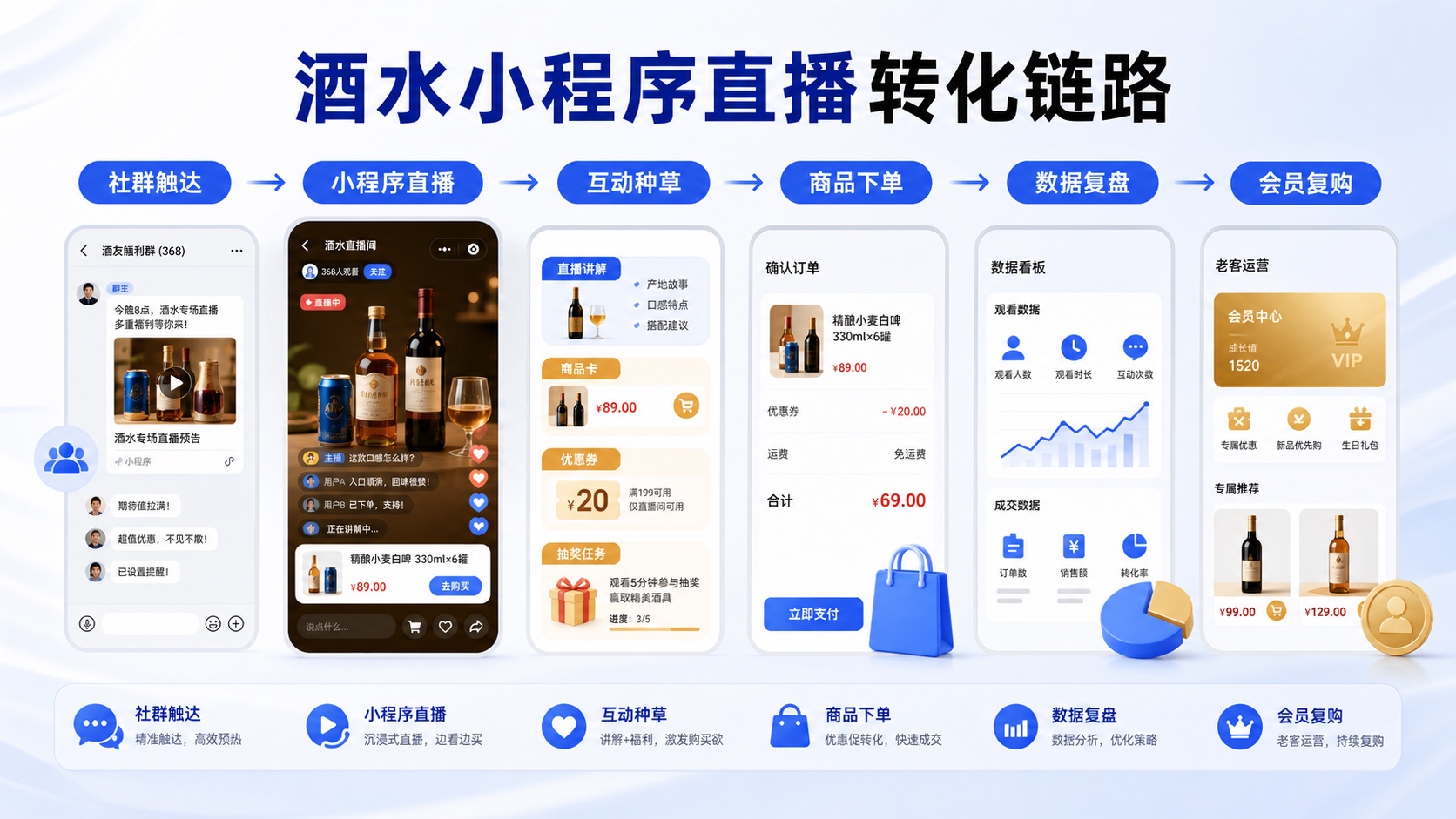
For these merchants, choosing a live streaming system should not stop at whether the stream can run. The real question is whether the system supports the complete operating chain.
First, it should connect quickly to the mini program and reduce the threshold for going live.
POLYV can provide a WeChat mini program live streaming SDK and related integration capabilities, helping merchants embed a live room into their own mini program or private-domain scenario. For wine and spirits retailers that already have a mini program, the key is not to rebuild a complex system, but to supplement the existing mini program with live streaming capabilities so users can watch, interact, and purchase from a familiar entry point.
This reduces the need to send users to multiple disconnected platforms and helps avoid drop-off caused by repeated jumps. For merchants still testing live commerce and operating with an unstable broadcast frequency, lightweight integration and fast validation are especially important.
Second, the live room should support interaction and product conversion.
Wine and spirits live streaming is not just about introducing product specifications. It needs to explain what to drink, how to choose, who to gift it to, and when to buy. The live room should support product cards, coupons, lucky draws, Q&A, comments, and other interactive tools so that the operating team can guide users at the right moment.
For example, when explaining that a certain product is suitable for holiday gifting, the merchant can push a gift-box product card. When introducing a tasting bundle, the host can guide users to claim a limited-time coupon. When viewers ask about taste or pricing, assistants can respond quickly and direct users to the product page. A good live streaming system does more than provide a player; it helps the team connect explanation, interaction, and purchase timing.
In real mini program live commerce scenarios, the live room is not only a playback window. After users enter, the system can guide them to log in to the mini program so they are not blocked from purchasing. During the session, operators can use announcements, comment areas, product entrances, and task-based activities to encourage users to stay, interact, and place orders. Lucky draws, viewing-duration tasks, and order-linked activities can also turn passive viewers into more engaged private-domain users.
For wine and spirits commerce, these operating components are particularly important. Customers often need more trust-building and scenario explanation before purchasing. The live room must explain the product, stimulate immediate interest, support ordering, and retain users for future repeat purchases. The advantage of mini program live streaming is that it can connect these actions inside a relatively closed private-domain environment.
Third, the system should accumulate data for review and repeat purchase.
The core value of private-domain live streaming is that user assets can be accumulated. After the live session ends, the merchant needs to know which product categories received more clicks, which explanation segments kept users watching longer, which users watched repeatedly without ordering, and which users should enter a membership, repeat-purchase, or group-buying follow-up process.
POLYV can help merchants review live streaming performance through live data, viewing behavior, and interaction data. For wine and spirits merchants, this data can inform the product selection for the next session, while also helping operators plan customer follow-up, community outreach, coupon distribution, and member activities. The live stream no longer ends when the broadcast ends; it becomes the starting point for continuous operation.
Fourth, the system should respect compliance and operating boundaries.
Wine and spirits are categories that require proper operating qualifications. Merchants need to pay close attention to product qualifications, promotional wording, purchase restrictions, after-sales statements, and related responsibilities. A live streaming system cannot replace the merchant’s own compliance obligations, but content management, replay retention, role permissions, live-room decoration, and operating workflows can help merchants run live activities in a more standardized way.
This becomes especially important when a merchant moves from occasional live sessions to team-based operations. The system should make clear who can start a live session, who can manage products, who can view data, and how live content is reviewed afterward.
04 Wine and Spirits Merchants Can Start with These Four Steps
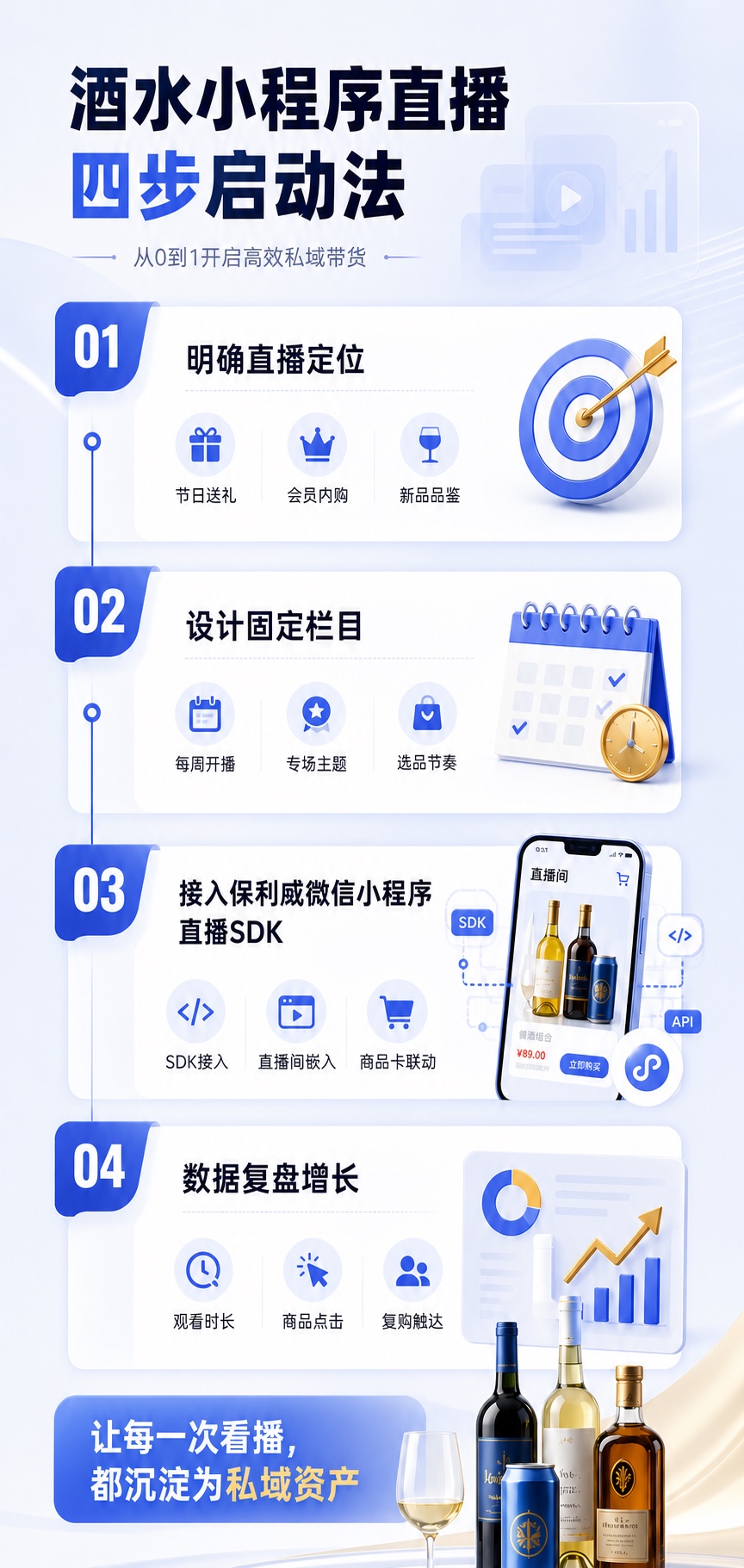
Step 1: Define the live streaming position first.
Do not pursue an overly broad setup at the beginning. A wine and spirits merchant can start with a clear scenario, such as holiday gifting, member-only offers, new product tastings, corporate group buying, or banquet beverage recommendations. The clearer the positioning, the easier it is to focus product selection and talking points.
Step 2: Design a fixed live program.
If the current broadcast rhythm is unstable, start with once a week or once every two weeks. Each session should solve one topic, such as “how to choose a gift under a certain price range,” “wine and spirits pairing for holiday family gatherings,” or “exclusive offers for existing customers.” Helping users know when to come and what they will see makes it easier to build habits than occasional ad hoc broadcasts.
Step 3: Integrate POLYV’s WeChat mini program live streaming SDK.
For merchants that already have a mini program, this step is not about starting from scratch. It is about embedding live streaming into the existing mini program journey. With POLYV’s WeChat mini program live streaming SDK, merchants can plan live entry points, live-room embedding, product-card connection, interactive components, and user data return, turning live streaming from an external campaign into an operating module inside the mini program.
The key is to plan technical integration and operating flow together. Before launch, the merchant should clarify where users enter the live room, when product cards appear, how customer service handles consultation, and how live data returns to later operations.
Step 4: Use data to review and optimize the next live session.
Do not evaluate only single-session sales. In the early stage, merchants should also look at entries, viewing duration, interaction count, product clicks, consultation questions, and repeat visits. Even if the first stage does not produce high sales immediately, identifying which products, price ranges, and consumption scenarios users care about gives the next live session a clear optimization direction.
05 Conclusion: Wine and Spirits Live Streaming Is Not About Noise, but About Accumulated Private-Domain Assets
Wine and spirits commerce does not lack stories or consumption scenarios. The real challenge is how to turn repeated explanations, interactions, and transactions into user assets that can be accumulated over time.
For merchants that already have a mini program, the required operating qualifications, and an intention to explore live commerce, mini program live streaming is not simply an added playback feature. It is an operating capability that connects products, content, users, and data. It helps merchants move from occasional broadcasts to stable programming, from judging whether the room is lively to judging whether users can be retained and converted again, and from temporary selling to long-term operation.
When wine and spirits live streaming returns to the merchant’s own private-domain base, what the merchant is really building is not just a live room. It is a repeatable user operation path that can be reached again, reviewed continuously, and converted over the long term.