
What VOD Capabilities Do Hong Kong Education Platforms Need to Enter Mainland China?
For Hong Kong education platforms entering Mainland China, VOD is more than video hosting. A China-ready video layer should support stable playback, content management, SDK/API integration, video security, learning data, and local service support.
For Hong Kong education platforms entering Mainland China, VOD is often one of the first pieces of video infrastructure that needs to be reviewed.
Whether the platform serves teacher training, student self-paced learning, course resource libraries, or digital learning services for schools and training organizations, video has become a core carrier of learning delivery. The real question is no longer whether the platform has video content. The more important question is whether those videos can be accessed steadily, played smoothly, managed properly, distributed securely, and converted into useful learning data in Mainland China.
For education platforms planning to expand into Mainland China, VOD should not be treated as a standalone feature. It is the video capability layer that supports course resources, learning experience, content security, and long-term operations.
In short: an education platform entering Mainland China should evaluate VOD capabilities across stable playback, content management, system integration, video security, learning data, and local service support. POLYV Cloud VOD can support course video upload, transcoding, distribution, multi-device playback, copyright protection, and data analytics, making it suitable as the video layer connected to an existing education platform.
01 Stable Playback: Make Sure Mainland Learners Can Watch Smoothly
The first requirement for education video is stability.
If a promotional video occasionally buffers, the viewer may simply close the page. But when a video carries course learning, teacher training, or exam preparation, playback quality directly affects course completion, user trust, and the perceived reliability of the platform.
After entering Mainland China, an education platform needs to consider playback experience across different regions, network conditions, and devices. Learners may watch courses on PC, mobile phones, tablets, apps, WeChat mini programs, or H5 pages. If the VOD system cannot support stable multi-device playback, even high-quality course content may fail to deliver the intended learning experience.
POLYV Cloud VOD supports video upload, transcoding, distribution, and multi-device playback. It can help education platforms embed course videos into websites, apps, mini programs, or self-owned learning platforms, reducing the cost and complexity of building video infrastructure from the ground up.
02 Content Management: Course Videos Need Long-Term Structure
Education VOD is not simply a video storage folder.
An education platform usually has multiple subjects, grades, training themes, and resource types. Once the number of videos grows, content becomes difficult to maintain without clear classification, tagging, folders, publishing controls, and batch management.
When entering Mainland China, the platform may also need to reorganize content based on local user habits. For example, courses may be displayed by grade level, subject, teacher development theme, course topic, learning task, or resource type. This requires the VOD system to support not only video upload, but also course-based operations.
POLYV VOD APIs and SDKs can support video upload, video editing, video markers, subtitle management, and courseware management. This helps education platforms connect VOD capabilities to their own course backend and manage video content together with the broader course system.
03 System Integration: VOD Should Fit the Existing Education Platform
Many education platforms already have their own website, account system, course catalog, and learning service flow. When entering Mainland China, the ideal approach is not to rebuild a separate video system, but to integrate professional VOD capabilities into the existing business architecture.
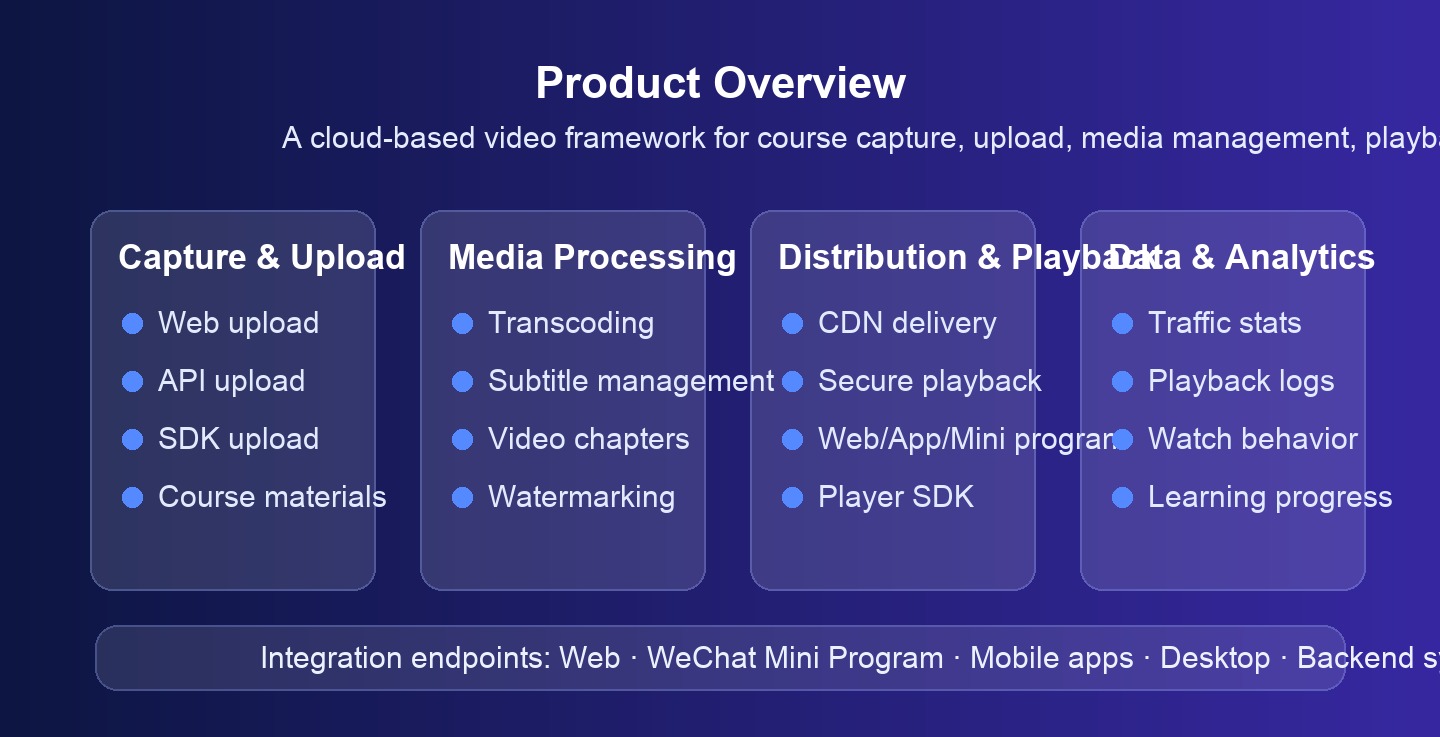
This is why SDK and API capabilities matter. The platform can continue using its own system to manage users, courses, permissions, and learning workflows, while POLYV Cloud VOD handles video upload, transcoding, playback, security, and data capabilities. To learners, the experience remains a unified learning platform. Behind the scenes, professional video cloud capabilities support the delivery chain.
For education platforms expanding across markets, this approach is often more practical. It keeps the original education service logic while adapting to the playback and integration requirements of the Mainland China market.
04 Video Security: Protect Course Content and Access Boundaries
Education videos often carry high content value. Teacher training courses, premium recorded courses, paid courses, and internal institutional resources can all become important digital assets. If these assets are downloaded, hotlinked, or redistributed, the platform’s content value and business model may be affected.
This means an education VOD system should provide layered security capabilities, including video encryption, anti-hotlinking, playback authorization, watermarking, access control, and viewing logs.
POLYV PlaySafe provides capabilities related to video encryption, anti-piracy playback, and screen recording deterrence. In VOD scenarios, it can also work with anti-hotlinking, video watermarking, URL authentication, and other mechanisms to increase the difficulty of unauthorized access and external redistribution.
It is important to be clear about the boundary of video security. No VOD system should be understood as a way to completely eliminate screen recording or account sharing. A more realistic approach is to combine encryption, authentication, anti-hotlinking, watermarking, and log tracking to raise the cost of misuse and support follow-up tracing when abnormal distribution occurs.
05 Learning Data: Move from Playback Statistics to Course Review
Education VOD should not stop at page views or play counts.
The more valuable data is learning-process data: which courses are watched repeatedly, which videos have obvious drop-off points, which knowledge points receive longer viewing time, and which learners show insufficient completion. These insights can help the platform optimize course structure and support teacher training, learning supervision, course recommendation, and teaching evaluation.
POLYV Cloud VOD provides data analytics around playback volume, watch time, and viewing behavior. For education platforms, VOD data is not only a backend report. It is an operational basis for improving learning services.
06 Local Service Support: From Integration to Long-Term Operation
Education platforms entering Mainland China also need to consider local service collaboration.
This includes product consultation, technical integration, deployment advice, user training, and ongoing operational support. VOD is not a one-time purchase. It becomes part of long-term content operations and platform service delivery.
Therefore, when choosing a VOD provider, education platforms should look beyond a feature checklist. They should also evaluate whether the provider understands education scenarios, can provide integration recommendations based on the platform architecture, and can support future extensions such as live classes, VOD, data dashboards, video security, AI-assisted course production, or private deployment.
Conclusion
For Hong Kong education platforms entering Mainland China, the core value of VOD is not simply to provide a player. It is to build a sustainable video capability layer for learning delivery.
The VOD system needs to support stable course playback, structured content management, integration with the existing education platform, copyright protection, and learning-process data. From this perspective, POLYV Cloud VOD can serve as a foundational video capability for education platforms entering Mainland China, helping course videos evolve from individual media files into learning assets that can be managed, protected, analyzed, and operated over time.