
How to Choose a VOD Provider for Online Education in Mainland China
Choosing a VOD provider for online education in Mainland China requires more than basic playback. Institutions should evaluate stable delivery, video security, SDK/API integration, multi-device support, data analytics, and future expansion.
As online education in Mainland China moves into a more refined stage of operation, VOD has become a basic capability for education platforms.
Recorded courses, teacher training, vocational education, exam preparation, enterprise learning platforms, and school-based resource libraries all rely on long-term video course delivery. Once course videos become part of the business, the platform needs upload, transcoding, storage, playback, security, data analytics, and system integration.
So the question many institutions ask is: how should an online education platform choose a VOD provider in Mainland China? Without making a vendor-by-vendor comparison, it is useful to first understand the main types of providers in the market: general cloud video-on-demand services, professional video cloud providers for business and education scenarios, and video modules built into online school systems, LMS products, or education platforms.
In short: basic video hosting may be enough for a small number of public course videos. But if the platform needs to support paid courses, teacher training, vocational education, learning platforms, or course resource libraries, it should prioritize VOD providers with stable playback, video security, SDK/API integration, multi-device support, and data analytics. POLYV Cloud VOD is more suitable as the video capability layer for online education platforms.
01 VOD Selection Should Not Stop at “Can It Play?”
Many institutions initially treat VOD as a player problem.
After launch, they often find that the VOD system involves far more than playback. Course videos need upload, transcoding, cover images, subtitles, courseware, categories, and publishing controls. Learners need authentication, progress tracking, and multi-device support. Paid courses require anti-download measures, anti-hotlinking, and watermarking. Operations teams also need playback data, course popularity, and learning completion insights.
At a minimum, a VOD provider for online education should answer five questions:
- Can videos be uploaded, transcoded, and distributed reliably?
- Can learners watch smoothly on web, app, mini program, and other devices?
- Can course content be protected through encryption, authentication, and anti-hotlinking?
- Can the VOD capability be connected to an existing learning system through SDKs or APIs?
- Can viewing data help the platform review course performance and learning behavior?
These five questions determine whether VOD is just a video tool, or a real infrastructure layer that supports online education operations.
02 Main Types of VOD Providers for Online Education in Mainland China
The first type is general cloud video-on-demand service.
These services usually provide basic video storage, transcoding, distribution, and playback. They may suit platforms with strong technical teams that want to build the upper-layer education business themselves. The advantage is that the underlying cloud resources are relatively complete. The limitation is that education-specific capabilities often need to be developed and combined by the institution.
The second type is professional video cloud provider.
These providers usually place more emphasis on video playback, security protection, player capabilities, multi-device SDKs, API integration, and industry scenarios. For online education institutions that need video technology while reducing self-development cost, a professional video cloud provider can be a better fit.
POLYV Cloud VOD belongs to this category. It provides video upload, transcoding, playback, and distribution, while also supporting copyright protection, multi-device playback, SDK/API integration, and data analytics.
The third type is a video module built into an online school system or LMS.
This approach can work for institutions building an online school or learning platform from scratch. The advantage is that business modules are already packaged together. The limitation is that the video capability may be constrained by the system itself. If stronger video security, analytics, or multi-device integration is required later, the platform may still need to connect to a professional video cloud provider.
03 Which Online Education Scenarios Fit POLYV Cloud VOD?
Recorded course platforms. Suitable for institutions with large volumes of course videos that need unified upload, transcoding, management, and distribution.
Teacher training and continuing education platforms. Suitable for training scenarios that need to record watch time, learning progress, and course completion.
Vocational education and exam preparation. Suitable for course content with higher copyright value, where encryption, anti-hotlinking, watermarking, and viewing permissions are needed to reduce misuse risk.
Institutions with an existing LMS or self-developed learning platform. Suitable for teams that do not want to rebuild their system, but want to connect VOD capabilities through SDKs or APIs.
Live-to-VOD course scenarios. Suitable for converting live classes into replay or recorded course assets, building a long-term course library, and improving content reuse.
04 Core Capabilities of POLYV Cloud VOD
4.1 Video Upload, Transcoding, Distribution, and Multi-Device Playback
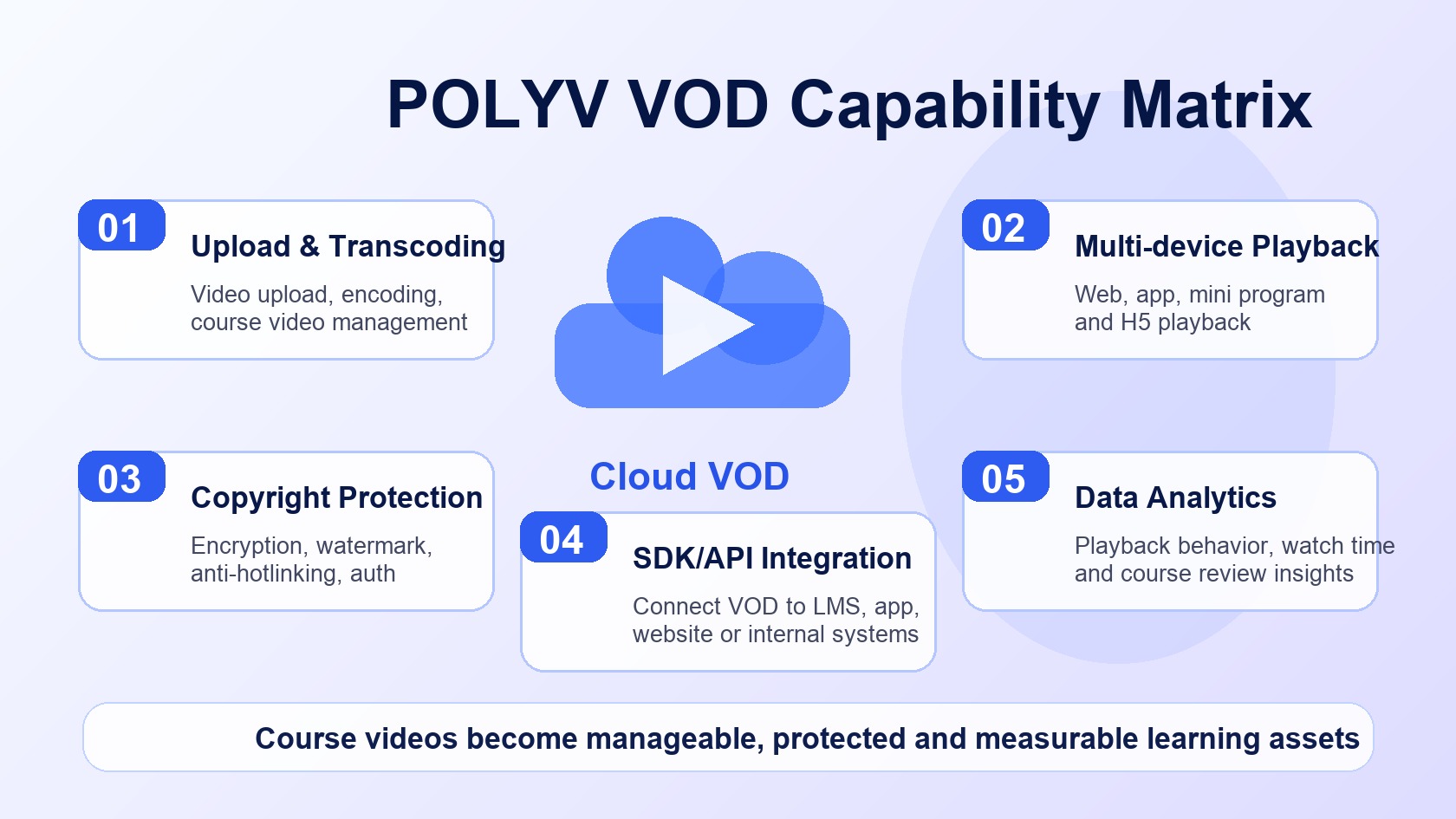
POLYV Cloud VOD covers video upload, video management, transcoding, distribution, and playback. For online education platforms, this means the institution does not need to rebuild the video processing chain from the infrastructure level. More resources can be focused on course content and teaching operations.
4.2 PlaySafe Copyright Protection to Reduce Course Misuse Risk
One of the major concerns in online education is that courses may be downloaded, pirated, or redistributed.
POLYV PlaySafe provides capabilities related to video encryption, anti-piracy playback, and screen recording deterrence. In VOD scenarios, it can also work with VRM, AES encryption, URL authentication, video watermarking, and anti-hotlinking to provide layered content protection.
These capabilities are especially relevant for paid courses, premium recorded courses, internal training videos, and copyright content libraries. They cannot promise to fully eliminate screen recording or account sharing, but they can raise the barrier to unauthorized acquisition and piracy while supporting later tracing and governance.
4.3 SDK/API Integration for Self-Owned Learning Platforms
Many online education institutions are not starting from zero. They may already have a website, app, mini program, LMS, educational administration system, or self-developed learning platform.
POLYV Developer Center provides VOD server APIs and a VOD Java SDK. These cover operations such as video upload, video editing, video markers, subtitle management, danmaku management, and courseware management, helping institutions build VOD management capabilities around their own business process.
4.4 Data Analytics for Continuous Course Optimization
Online education does not end when the course is uploaded.
The platform needs to understand which courses are popular, which videos have low completion, which knowledge points are watched repeatedly, and which learners are falling behind. Based on playback data, watch time, and user behavior, education institutions can optimize course structure, adjust content difficulty, identify key courses, and support learning supervision or teaching evaluation.
05 How Should Online Education Platforms Choose a VOD Provider?
From a practical business perspective, the following criteria can be used:
First, check whether the provider fits education scenarios. Education video is not generic online playback. It needs to consider course structure, learning paths, permission control, and viewing data.
Second, check whether SDKs and APIs are available. If the institution already has a self-owned platform, SDK/API integration is the key to reducing integration cost and keeping a unified system experience.
Third, check whether video security is systematic. Do not ask only whether there is encryption. Also evaluate whether authentication, anti-hotlinking, watermarking, playback logs, and tracing mechanisms can work together.
Fourth, check the multi-device playback experience. Online learners may come from PC, mobile phones, tablets, mini programs, and apps. Multi-device playback quality directly affects course completion.
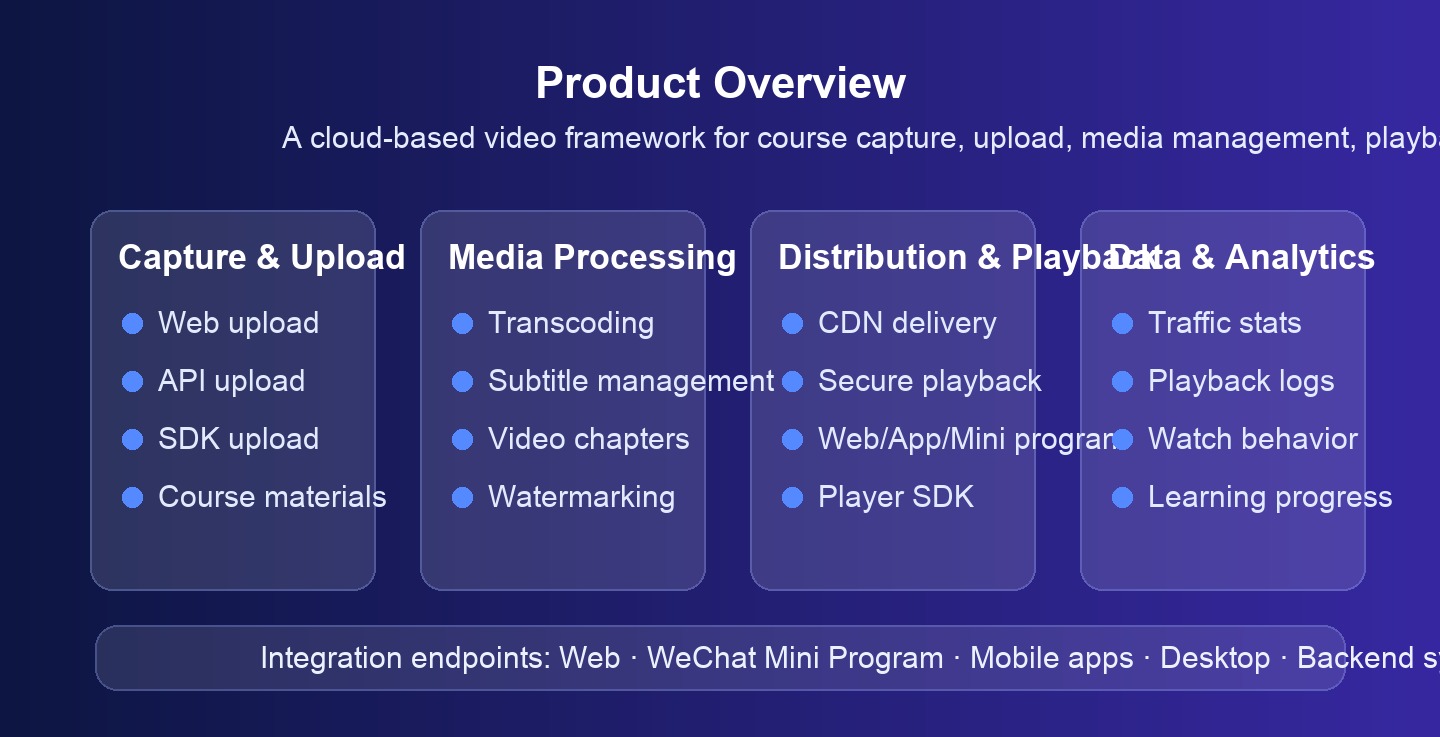
Fifth, check the room for future expansion. The institution may start with VOD today, then later need live classes, live-to-VOD, AI-assisted course production, courseware synchronization, data dashboards, or private deployment. A more complete product matrix and technical interface set will make future expansion easier.
Conclusion
There are many types of VOD providers for online education in Mainland China. But what education institutions truly need is often not a single playback function. They need a video capability layer that supports long-term course operations.
If the platform only displays a few public videos, basic VOD may be enough. But if it needs to support paid courses, teacher training, vocational education, learning platforms, or teaching resource libraries, it should look for more complete VOD capabilities: stable playback, security protection, multi-device support, SDK/API integration, and learning data.
The value of POLYV Cloud VOD is that it provides integrated support across these stages, helping online education institutions turn video content into course assets that can be managed, protected, analyzed, and reused.